Goal-Setting

Napoleon Hill, in his classic work, Think & Grow Rich, wrote that on the path to success, “Persistence is key. You will have temporary defeats. That’s a given. But don’t give up.”

He went on to say that,

“Most of us are good ‘starters’ but poor ‘finishers’ of everything we begin. The persistent person discovers that ‘Old Man Failure’ finally becomes tired and goes away. Failure cannot cope with persistence.

Good words.

But how do you persist? How do you overcome — or prevent — the fatigue and frustration that can derail your journey?

I asked Gretchen Rubin, author of the #1 New York Times Bestseller, The Happiness Project, about that on Friday afternoon… with emerging speakers and authors in mind (and even those who are established, but have their sights set on the “next level”).

The Happiness Project BookGretchen has achieved the success that many speakers and authors dream of:

  • her book hit #1 just weeks after its release
  • it remained at #1 for several weeks
  • it’s remained on the list in one form or another for roughly 25 weeks (the paperback version sits at #8 right now)
  • the book is now more than a book — it’s a global movement, with Happiness Project groups springing up around the world, hundreds of book discussion groups forming, and rights for more than 32 foreign editions being sold
  • she has over 55,000 people on her newsletter list, over 44,000 Facebook fans, and over 40,000 Twitter followers

Sounds great, right? Another story of overnight success. Right? Wrong.

You may have heard that it takes 10 years to become an overnight success…

Well, Gretchen’s first book was published in 2001. The Happiness Project, her fourth book, was published in late 2009 and hit #1 on the NYT bestseller list in January 2010. Pretty close.

And even that one book wasn’t born overnight. It was almost six years ago when Gretchen first got the idea to start her own happiness project, and a little bit later when the book idea was born.

So, needless to say, she persisted.

That’s why I wanted to ask her, “What advice would you give to other speakers or authors who are still waiting for their breakthrough moment?”

Here’s what she said:

“You can’t hold out for the big finish. Not all of my books found an audience like The Happiness Project, but all of my books were such a joy to write — for me — that I wouldn’t undo them. Enjoy the process. A lot of things are outside your control and you won’t always get what you want or even deserve. Banking your happiness on hitting the bestseller list or some of these other external goals is very risky.”

I’ll have more from Gretchen next week — about how she keeps up with her blog, newsletter, Facebook page and more — but for this week, I encourage you to persist, and perhaps to ask yourself:

Are you enjoying the process?

Learn more about Gretchen Rubin and The Happiness Project by visiting http://www.happiness-project.com, and if you’d like to bring some extra happiness into your life, I encourage you to buy her book, subscribe to her blog, or sign up for her monthly newsletter by emailing her with “newsletter” in the subject line.

He made $5.6 million in 24 months.

She sold 2 million books last year.

She has over 10 million Twitter followers.

He just spoke to an audience of over 5,000 people.

Oooooooo…. impressive!

We love big numbers, don’t we?

Are big numbers attached to any of your goals?

Probably so… and there’s nothing wrong with that.

Here’s the problem, though: We dream of these big numbers, but we often forget that to get to that big number, we have to start at one.

One. Yuck. Boring. Why waste my time on that?

Ever feel that way?

Or what about this: Ever hear that he booked seven figures in business last year and then look at your own business — with smaller numbers — and feel like you must be doing something wrong?

Big numbers trip us up all the time. I’m not sure if it’s society, culture, capitalism or just human nature.

But this week’s message is just a simple reminder:

EVERYTHING BIG STARTS WITH one.

Want to get a standing ovation? You have to move one person in the audience first… and then another… and then another.

Want to reach 10 million people? You have to start with one — and it may be (often is) the unlikeliest one you’d think of.

Want to make a million dollars? You have to make one dollar first… and then $10,000… then $50,000… then $100,000… then $500,000…

Want to sell 5 million books? You have to sell one first. And before that you have to write one. And before that you have to write a chapter. And before that you have to write a page.

You get the idea, I know.

So do I.

But if you’re anything like me, occasionally you forget.

Today I’m reminding myself. And you, if you need it.

What ONE thing are you going to do today?

What ONE person are you going to inspire?

What ONE person are you going to notice?

It all starts with one.

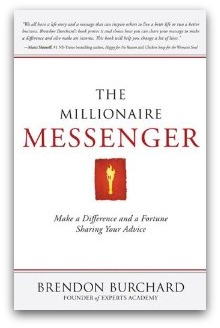
If you’ve followed me and Succeed Speaking for any length of time, you know I’m a big believer in Brendon Burchard. I was first introduced to him by Jack Canfield’s team, and wow, this guy knows his stuff.

Brendon started out as a simple guy with a great message, and he turned his advice and life experience into a brand that changes millions of people’s lives. Because of his success, he created Experts Academy, which is a comprehensive program that trains other authors, speakers, seminar leaders and online marketers how they can follow his same model.

The only problem with Experts Academy is that it costs $2,000-5,000 to enroll. That’s not a problem in terms of value, but obviously it’s a significant investment and an obstacle for a lot of people. So… Brendon wrote The Millionaire Messenger, taking many of his best lessons from Experts Academy, as well as his own multi-million dollar strategies for sharing his message — all in one affordable book.

The book isn’t just affordable, though… it’s FREE for a limited time! Grab your copy here (you just have to pay shipping).

Why is Brendon giving the book away for free? Simple. To get some early reviews on Amazon.com, build buzz, and if all goes well, have a New York Times Bestseller right out of the gate. Pretty smart, huh? Win-win for everyone.

Even if you don’t buy the book, there are plenty of lessons to be learned just by studying how Brendon has set up his launch strategy. Enjoy!

DISCLAIMER: The book is free (except shipping and handling) and I make nothing from it, but I am an affiliate for Brendon’s other materials, so if you end up buying something from him in the future, I may be paid a commission. Just want to be fully transparent about that.

How would you like to…

…be more excited about your work?

…be more confident on stage?

…make a more powerful impression on your clients and audience members?

…get more repeat and/or spin-off business?

…sell more products?

You can. And it all starts with saying… “No!”

Let me explain.

What is one of your major goals as a speaker? To book dates, right? That’s why, when the money’s on the table with a firm offer and your calendar’s open, the easiest thing to do is say, “Yes! Book it!” But I encourage you to practice the art of saying “No.”

To really build a great speaking business — to experience “more” of everything I listed above — you don’t want to just book dates. You want to book quality dates — dates that:

  • Are aligned with your “sweet spot” (an industry/sector/audience you can effectively connect with, and the topic/theme that really allows you to shine)
  • Are with clients you enjoy working with — clients who energize you rather than drain you (HINT: if you’re inclined to send a particular client’s calls to voicemail, that’s probably not a client you should be working with)
  • Are set up for you to succeed, from a technical/logistical standpoint (for example, having a time slot at the end of a 3-hour awards banquet would not qualify)

When you participate in engagements that meet these criteria, wonderful things happen.

But as you well know, not every invitation that comes in does meet these criteria. Sometimes the audience just isn’t the right fit. The topic is just a little left of where you shine. The client rubs you the wrong way… and asks for more and more and more… at a rock-bottom price.

Have you ever accepted one of those dates?

Sure you have. We all have. And we regret it afterward.

Saying “no” isn’t easy, but sometimes it’s the right thing to do. Don’t be afraid.

I remember recently I was talking with a prospective mentoring client — a speaker I’ve known and respected for a few years. I wanted to work with him. He started suggesting slight tweaks to the mentoring framework I had designed very purposefully, and in an effort to accommodate, I made adjustments. But with tweak after tweak, I realized that the program was no longer one that (a) excited me and (b) I was confident in. So I pulled out. I knew I would regret saying “yes” a lot more than I would regret passing up the mentoring revenue.

We’ve made similar decisions in our speakers bureau business — either to take a pass on business, or to “fire” a client who clearly wasn’t right for us. Never have we regretted it.

All the good things you want for your business come from working with clients who are right for you… events that are right for you… audiences that are right for you.

You will never build a great business by accepting engagements that aren’t a good fit. You may put money in your bank account, but you won’t build a great business.

So there you have it — my “just say no” public service announcement. :-)

If you’d like more help on this topic, work through this free exercise from Michael Port to implement what he calls the “Red Velvet Rope Policy” (from his Book Yourself Solid book)

As seen in the Succeed Speaking Newsletter:

Optimism and ambition always abound at this time of year. We all have high expectations for the year ahead. Right? What are your big goals?

The good news is, indications are that the speaking market will be better this year. We closed 2010 strong at The Speakers Group and several speakers shared similar reports with me.

I don’t believe the speaking market will ever look like it once did — that’s partly due to economic reasons, partly due to advancing technology, partly due to… well… time moving forward. We must never become too attached to doing things a certain way, because if we do, progress will run right over us. But opportunity for growth and even greater success than we’ve ever experienced is there. Here’s the bad news:

Opportunity is missed by most people because it is dressed in overalls and looks like work. – Thomas Edison

I’ve loved that quote since the first time I heard it. For one thing, I spent many summers growing up working on the farm with my grandpa. He showed me what hard work is all about — and he wore overalls — so that quote makes me think of him. Beyond that, though, it’s just a great reminder that success is there to be had by all of us… if we’re willing to go to work.

When you look across history, if we look at all who have prospered and try to boil their success down to one factor, I think “hard work” would be the most common denominator. I know it’s not as sexy as the “Law of Attraction.” I know that every now and then someone gets lucky. (But I would argue that luck isn’t sustainable without some hard work to go with it. Ever heard that line: “The harder you work, the luckier you get”?)

There was a Fortune magazine article a few years ago about “What It Takes to Be Great” and the conclusion, based on scientific research, was that, “You will achieve greatness only through an enormous amount of hard work over many years. And not just any hard work, but work of a particular type that’s demanding and painful.”

Hard work. Demanding. Painful. Doesn’t sound like much fun, does it?

That’s why, when I advise aspiring or emerging speakers who want to join the ranks of world class speakers, I start with talking about passion and purpose before ever getting to presentation skills or marketing or demo videos. I don’t believe anyone can achieve greatness — it’s too hard — without first being aligned with their passion and purpose.

But when you are doing what you love, and when you believe in what you’re doing, that’s the fire that will push you through that demanding and painful hard work which will lead you to prosperity… to greatness.

So, as we kick of 2011 and set our sights on some big goals, I want to first remind you to make sure your vision is aligned with your purpose in life, and that it will allow you to work in your “passion zone” every day. If not, you might want to rethink it.

If the alignment does check out, well done. Now it’s time to go to work!

If you’re committed to working harder, then I’m committed, with the Succeed Speaking newsletter, to give you tools, tips and strategies each week to help you work smarter. Together, we could be a good combo, don’t you think?

Have fun in 2011! Do good!

We’re well into the fourth quarter of 2010, and while you’re working away to close the year strong, it’s not too early to start thinking about how you’ll attack 2011.

Here are 21 ideas to give you a spark (in no particular order):

  1. Make a plan. (As basic as it sounds, how many of us have been guilty of just “winging it”?)
  2. Launch an e-learning program. Virtually everyone you speak to during the year is a potential enrollee, as are your book buyers, website visitors, and others. You could even offer customized programs for individual client organizations as add-ons to your keynotes.
  3. Target new, largely untapped (by you) sectors or industries. Maybe there’s a particular market you’ve always felt you could help, or maybe you’ve had great success with a few companies in a certain industry. Develop and launch a campaign with maximum relevance for those prospects.
  4. Think about how you can educate prospective clients about what you can offer and how you can help them instead of just how you can “advertise” to them — a subtle, but significant shift.
  5. Update and/or enhance your website. Make it a more valuable resource for visitors (of all sorts, from consumers, to planners, to executives) and load it with content that will improve your search ranking for your most desired search terms.
  6. Start (or overhaul) your e-newsletter. Consistently sharing valuable content with prospective clients and customers is a great way to cultivate business.
  7. Write more articles and submit them to key publications. Don’t forget you can recycle (and update) past articles, have portions of your keynote(s) transcribed, or hire a ghostwriter — the important thing is to get your content “out there.”
  8. Seek out partnership opportunities with key entities/organizations. There are organizations who either already have access to the markets you want to reach, and likewise, there are organizations who want to reach the markets you have access to — get creative and create win-win initiatives.
  9. Lower the barrier to entry for prospective clients and customers. What options do you currently have for someone to buy from you, book you, or hire you? Offer some valuable resources for free to get people in the door. Instead of offering just a keynote, would offering virtual programs like webinars make you more accessible to certain clients? Obviously you want the “big sale,” but you’ll lose a number of the prospective “big sale” customers if you don’t offer intermediate options.
  10. Create content that attracts interest and establishes credibility. Articles and e-newsletters are examples, but what else could you offer? A podcast? E-books? Webinars? Great content is great marketing!
  11. Create a viral video. You may have heard of “The Time Movie” — that simple little video has been seen over four million times since it debuted in 2003. What would happen if 4,000,000 people were introduced to you?!
  12. Start (and regularly update) a blog. (This is another application of #10 above.) For improved efficiency, you can use your blog content to put your e-newsletter on autopilot.
  13. Collect more email addresses (from your website visitors, event attendees, book readers, everyone!) and market appropriate products, services and solutions to them.
  14. Do an inventory of your business assets (contacts, relationships, content, marketing materials, etc.) and look for untapped opportunities to leverage them. For example, do you have quality content that’s currently collecting dust? There’s material for your e-learning program, blog, newsletter, articles, and more. (See how so much of this ties together?)
  15. Define your goals. This is not to be confused with #1 — “Make a plan.” You make a plan to achieve your goals. It’s hard to plan if you don’t know where you want to go!
  16. License your content to associate speakers, coaches or trainers. To me, a successful speaking business is one in which you maximize your reach and maximize your revenue (and specifically, your profits). It’s hard (actually, impossible) to do that if you don’t involve others.
  17. Send note cards or greeting cards to contacts to show appreciation and stay top of mind. With overloaded inboxes and mailboxes full of unwanted advertisements, personal notes go a long way. Send a free card right now.
  18. Team up with complementary (not competing speakers) on a marketing campaign. This is a great way to maximize your investment and boost the effectiveness of a campaign.
  19. Engage with a coach, consultant or mentor to help you reach new heights. If there’s a ceiling or obstacle you haven’t been able to break through yet, a coach who can challenge you, teach you and inspire you may be the missing ingredient.
  20. Create a consistent follow-up plan with existing leads, past clients, etc. These “warm” leads are among the most fruitful — especially if you come to them with new content or new offerings to consider.
  21. Outsource as much of the above as possible. Of course you’ll want to be involved, and there are some things that you just have to do yourself. But I’ve learned the hard way that one of the most dangerous traps for entrepreneurs and small business owners is the “I can do it all” or “I want to do it all” mentality. Look for opportunities to delegate marketing and support tasks and watch productivity and results — and your happiness — skyrocket. (Speaking of outsourcing, we might be able to help… check out our new service offerings!)

Which of these ideas do you like best? Have any you’d like to add? What are your big plans for 2011? Leave a comment below!

12